Disclaimer
This reflection is based on publicly available information gathered from national and regional news platforms, as well as discussions circulating on social media and other internet sources. I do not claim to have verified the precise operational realities within the plants discussed.
More importantly, this is not an evaluation of any specific company or individual. The organisations and stakeholders involved are not the subject of judgment here. Instead, this piece attempts to understand systemic patterns within Industrial and Employee Relations and the risks they may create if left unaddressed. The intent is academic, not accusatory, an exercise in learning, not labelling.
 A Pattern Across Places: Panipat, Hazira, Singrauli
Across three geographically distant industrial sites, Panipat, Hazira, and Singrauli, events unfolded in close succession during early 2026. Each incident had its own trigger, yet all seemed to echo a similar structural strain.
At the Panipat Refinery & Petrochemical Complex of Indian Oil Corporation Limited, a tragic workplace accident reportedly led to loss of lives and triggered large-scale worker unrest.
At Hazira, within operations linked to ArcelorMittal Nippon Steel India and executed by Larsen & Toubro, unrest emerged rapidly, seemingly catalysed by circulating visuals and underlying dissatisfaction.
At Singrauli, at a facility operated by Adani Power, a worker’s death reportedly led to conflicting narratives and subsequent escalation.
The specifics may vary. But the patterns invite reflection.
From Incident to Escalation: What Connects the Dots?
From an Employee Relations (ER) standpoint, what is striking is not merely the occurrence of unrest, but the speed and scale of escalation.
Three elements appear consistently:
1. Trigger Events Are Immediate, But Reactions Are Accumulative
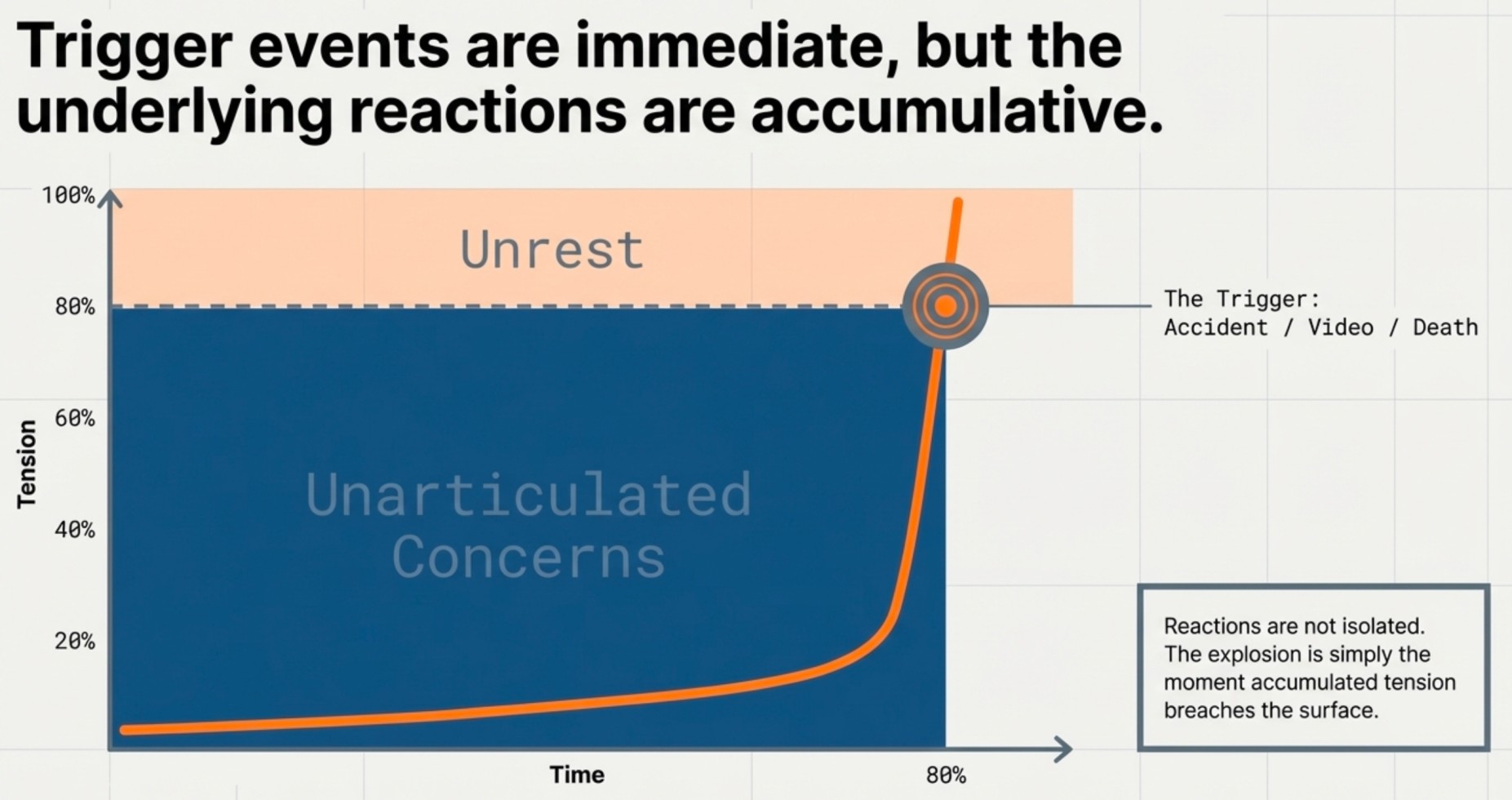
An accident. A video. A death.
Each incident had a clear starting point. Yet the intensity of the response suggests that these were not isolated reactions, but expressions of accumulated concerns, some voiced, others perhaps unarticulated.
2. Perception Often Outpaces Fact
In all three cases, what workers believed to have happened played as significant a role as what may have actually occurred.
-
Delay in medical response becomes perceived indifference
-
Lack of clarity becomes perceived concealment
-
Silence becomes perceived intent
In ER, perception is not secondary to reality, it is often the operational reality.
3. Informal Networks Now Shape Formal Outcomes
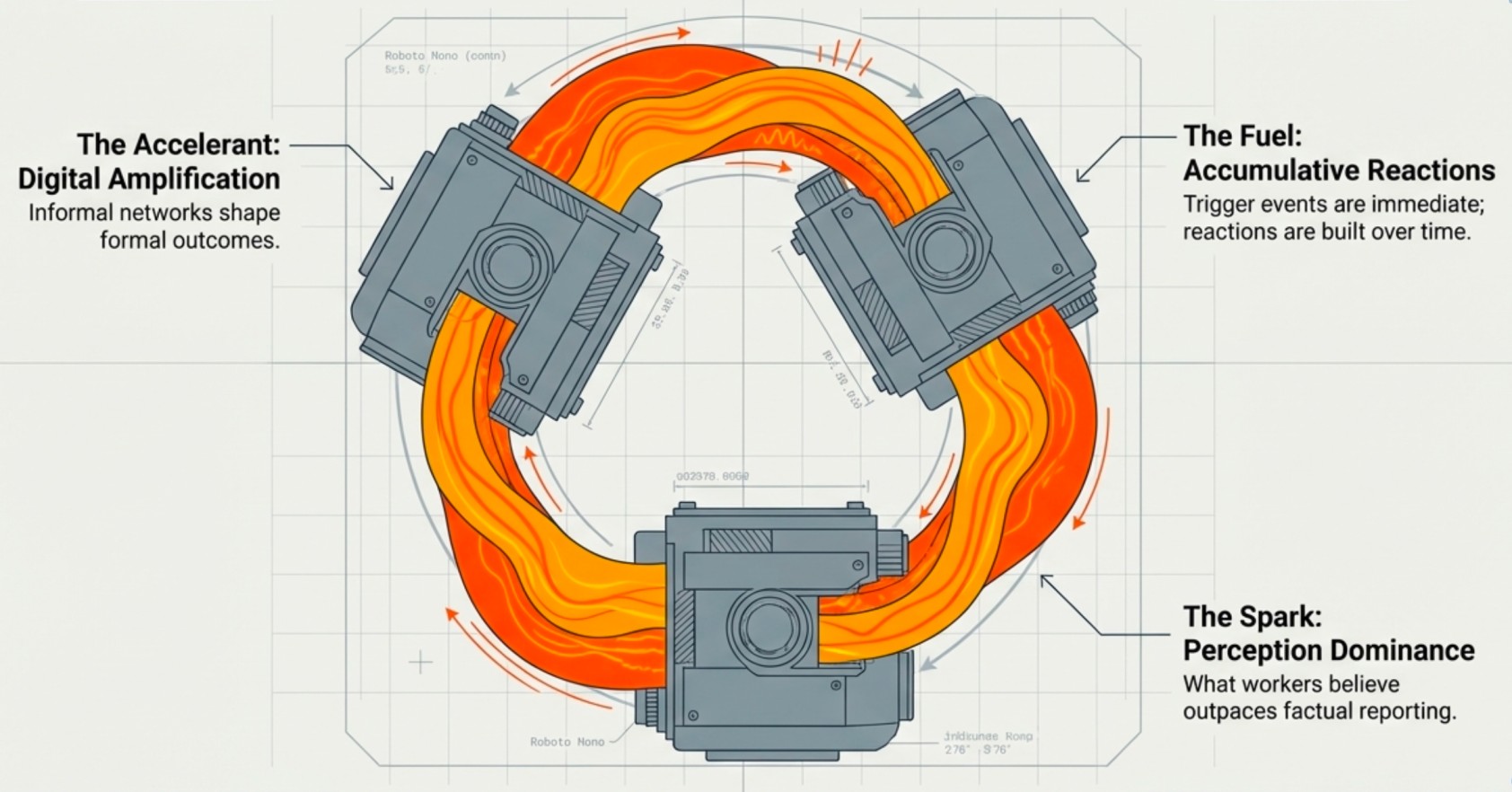
The Hazira incident, in particular, underscores a critical shift: information no longer flows top-down.
Workers today are part of digital communities, WhatsApp groups, Telegram channels, and peer networks across sites and states. Narratives travel faster than official communication, and often arrive earlier.
This creates what may be termed a “digital amplification effect”, where one local incident acquires national emotional resonance.
Key ER Reflections: Systemic Vulnerabilities
Without attributing intent or fault, these incidents highlight certain structural vulnerabilities that ER professionals must increasingly engage with:
I. The Expanding Scope of the Principal Employer
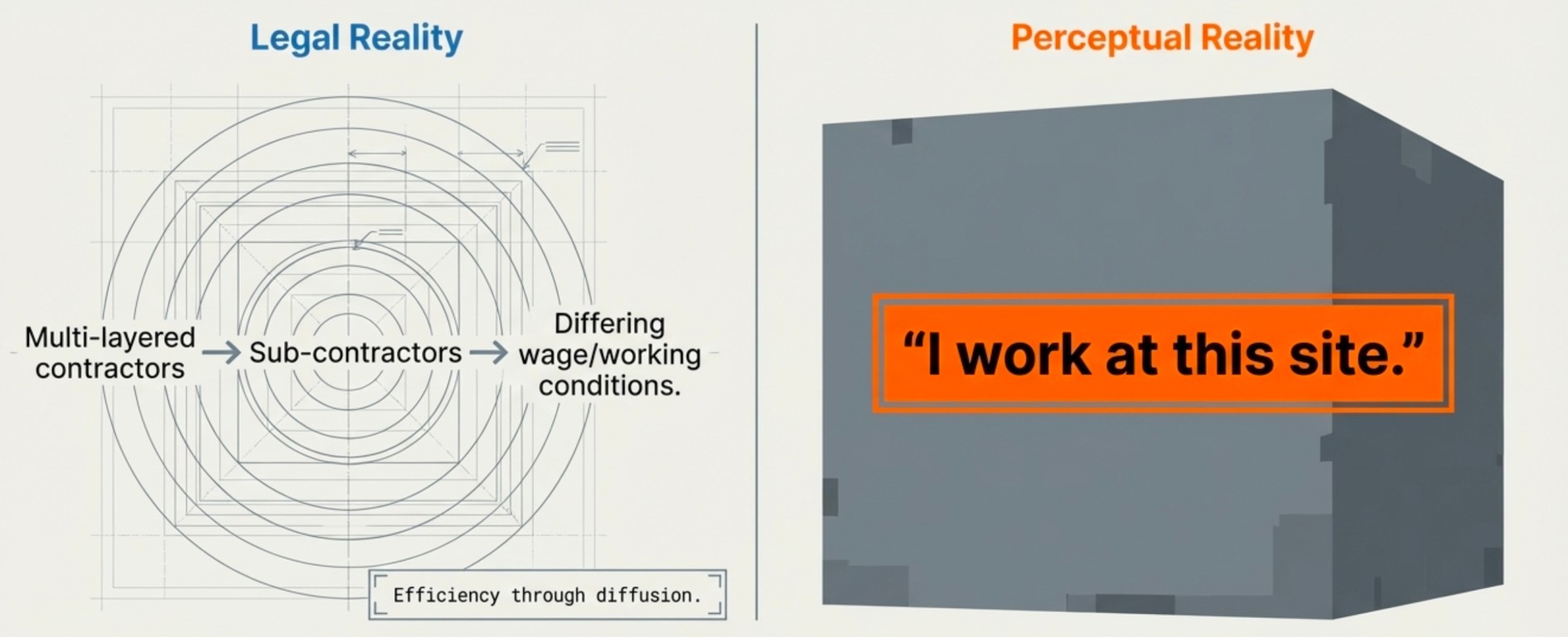
In complex contractor ecosystems, the distinction between “direct” and “indirect” employees may exist legally—but not perceptually.
Workers often associate their experience with the site rather than the contractual chain.
This creates an important ER consideration:
Responsibility may be delegated operationally, but accountability remains perceived centrally.
II. The Silent Risk of Grievance Gaps
Where formal grievance mechanisms are weak, inaccessible, or mistrusted, dissatisfaction does not disappear; it redistributes.
Often into:
-
Informal group discussions
-
Collective frustration
-
Sudden, unstructured escalation
A “silent” workforce is not necessarily a “satisfied” workforce.
III. Crisis Communication as a Core ER Capability
In high-intensity environments, the first response sets the tone for everything that follows.
Not all crises can be prevented, but their trajectory can often be shaped by:
-
Speed of acknowledgment
-
Visibility of leadership
-
Clarity of communication
Delays, even unintentional ones, create interpretive space, and that space is rarely generously filled.
IV. Fragmentation Within Contractor Ecosystems
Multi-layered contractor structures, while operationally efficient, may create diffusion in:
-
Wage practices
-
Working conditions
-
Accountability
From an ER lens, inconsistency across these layers can gradually erode trust, particularly when workers perceive differential treatment or opacity.
An Emerging Reality: ER Beyond Compliance
Traditionally, contractor management has focused on compliance indicators such as PF, ESI, wage registers, and statutory filings.
While necessary, these may no longer be sufficient.
There is a growing need to engage with what may be termed:
“Experiential Compliance”
-
Are working hours perceived as fair?
-
Are living conditions dignified?
-
Are workers able to raise concerns without fear?
Because ultimately:
Compliance ensures legality. Experience determines stability.
What Might Help: A Forward-Looking View
Without prescribing solutions, a few directional thoughts emerge:
-
Bridging Interfaces: Creating accessible channels between contract workers and principal employer representatives
-
Transparency in Moments of Uncertainty: Especially during accidents or sensitive incidents
-
Consistency Across Layers: Aligning contractor practices with site-level expectations
-
Understanding Workforce Sentiment: Not just through reports, but through regular engagement
Conclusion: A Question Worth Asking
As I returned from that afternoon's drift into the digital world back to the immediacy of office life, one thought lingered.
Industrial relations is often discussed in terms of laws, compliance, and frameworks.
But at its core, it remains profoundly human.
And perhaps the real question is not whether systems are in place, but whether they are felt.
Because where systems are seen as distant, and voices as unheard, even isolated incidents can acquire disproportionate force.
Not necessarily because of what happened, but because of what it seemed to represent.
Comments (0)
Please log in or register to leave a comment.
No comments yet. Be the first to share your thoughts!